

Huck rivets in steel construction.
Construction plays a vital role in the steel industry, accounting for over 50% of global steel demand. Ensuring resilience and strength in a diverse range of structures including houses, hospitals, schools, and high rise. In modern houses, there's been a surge in the use of steel. It's more than a passing trend; it's reshaping how we build our homes. The incredible versatility of steel means you will find it in numerous building facets – from the timeless Colorbond® roofing and robust steel frames through to essential downpipes, windows and ventilation shafts. Anywhere you need a reliable connection you will need a fastener.
When considering fasteners, there are countless rivet options for starters from every day pop rivets through to super strong Huck® rivets . Huck® rivets are the tried and tested high strength industrial strength structural rivet. These heavy duty fasteners play an important role in construction, bringing a multitude of benefits and advantages. With structural rivets, you can enjoy enhanced durability, adaptability and cost-effectiveness due to their one side-installation process. Huck® structural blind rivets can provide an efficient mechanical fastening option when correctly specified and installed with compatible tooling. Inspection and maintenance requirements depend on the application and service conditions.
Aerobolt supplies a range of Huck® structural blind rivets for industrial fabrication, modular construction and selected building applications. Products such as Huck® Magna-Lok® and HuckLok® provide different grip ranges, material options and mechanical fastening characteristics.
For load-bearing steel connections, roofing assemblies and other critical applications, the selected fastener must be assessed against the joint design, substrate materials, expected loads, environmental exposure and relevant construction requirements. Final fastener selection and connection design should be verified by a suitably qualified engineer or designer before installation.
Structural rivets work a little differently from your typical pop rivet. A structural rivet has a built in locking mechanism that is engineered to hold a portion of the pin inside the body of the rivet for extra strength compared to a general pupose blind rivet. This provides for
- Increased Shear and Tensil strength.
- Higher resistance to vibration.
- Weatherproof and moisture-resistant fastening characteristics. Weatherproofing of the complete assembly must be assessed separately.

High strength structural rivets and modular construction.
The modern modular off-site construction industry consists of two distinct segments: re-locatable modular buildings and permanent modular buildings. Both segments involve manufacturing units off-site, which are then assembled on-site by stacking and/or adjoining the finished modules. Huck® structural rivets are the ideal choice for fastening applications in the modular construction sector due to their quick and easy installation process.
Re-locatable Modular – These temporary modular buildings are ideal for situations that demand quick construction. They must also be durable enough for future relocation and repurposing. Examples include: temporary classrooms, bathroom cabins, communication pods, show rooms, job / site trailers and glamping pods.
Permanent Modular Construction (PMC) – PMCs are designed to remain in one location for an extended period of time. Examples include: schools / student accommodation, healthcare facilities, hotels, food kiosks etc.
The key benefits of using Huck® rivets in the above-mentioned applications include:
- Single (or blind) side assembly for faster installation: With blind side assembly, there is no need to access the back of the joint, resulting in quicker and more efficient installation.
- Exceptional robustness and durability: Huck rivets provide a mechanically activated permanent joining solution, ensuring strong and long-lasting connections.
- Simple and efficient installation with air or cordless Huck tools: Installing Huck rivets requires minimal effort and training, thanks to the user-friendly design of the air and cordless tools.
- Design flexibility with a wide range of rivet types and materials: Huck offers a diverse selection of rivets, allowing for customization and adaptation to suit various applications.
- Easy inspection and maintenance without expensive equipment: Quality control is made easier as Huck rivets can be inspected and maintained without the need for costly specialised equipment.
Enhanced on-site productivity during the assembly phase ensures that the cost savings of modular builds can increase with production scale. Offsite assembly based on ‘template’ builds means that approved designs can be reused and mass produced quickly and easily. Standardised off-site fabrication and repeatable assembly processes may help modular construction projects improve production efficiency and reduce rework.
Huck® structural blind rivets provide permanent mechanical fastening solutions, with selected products incorporating locking features designed to resist loosening under vibration. Long-term joint performance depends on correct fastener selection, installation quality, environmental conditions and overall joint design. Periodic inspection or maintenance may be required depending on the application.

Huck® rivets have high tensile, shear, and clamp properties, making them suitable for applications where joints are integral to the structure. Huck® structural blind rivets may be considered as an alternative to certain welded or bolted connections where the proposed fastening method has been assessed and approved for the specific joint design.
Huck® blind rivet advantages.
Huck® structural rivets provide durable, vibration-resistant fastening solutions, along with several other benefits including:
Performance and quality – Huck rivets are meticulously designed to meet precise installation standards needed for prefabricated structures. In the rigorous journey of modular buildings, they must endure the vibrations and jolts while being transported on trucks, as well as the strains of craning to their designated final location. Once positioned, these buildings face nature's challenges, braving the scorching sun, gusts of wind, and relentless rain – consistently demonstrating their resilience and durability
Huck® Rivet Types.
When access is limited to only one side of the joint material, performance-engineered Huck® structural rivets offer the ideal solution. These rivets are designed and engineered to overcome common manufacturing obstacles. Their diverse range of features allows them to excel in hole-filling, water-resistance, accommodating wide grip ranges, and even serve as a welding alternative. These rivets ensure high-speed assembly while delivering effective and tailored solutions that meet your unique manufacturing requirements.
The HuckLok® and the Magna-Lok® are two highly popular Huck® blind fasteners extensively employed in modular construction. These fasteners possess exceptional features that set them apart, such as a distinctive mechanical lock ensuring optimal strength in loaded conditions and the ability to completely fill holes, enhancing moisture resistance.
HuckLok® - The multi-grip super strong Huck structural rivet.
Hucklok® is a structural blind rivet featuring a wide grip range and a double-locking mechanism. Its installation process forms a mechanical connection between the rivet pin and sleeve, while the large blind-side footprint helps distribute the load and resist pull-through.
HuckLok® is designed for applications requiring high shear strength and reliable mechanical fastening. Suitability depends on fastener diameter, material, grip range, joint geometry and expected loading. Refer to the manufacturer's technical specifications when selecting a fastener.

Magna-Lok® - The perfect all-rounder blind structural rivet.
Huck® Magna-Lok® is a structural blind rivet featuring a wide grip range, hole-filling capability and an internal mechanical locking system.
The Magna-Lok® circle-lock design incorporates a visual installation indicator that assists inspection of the completed fastening operation. Available in several material options and diameters, the product can be used in selected industrial and construction-related assemblies.
Fastener selection should consider the specified grip range, hole dimensions, material compatibility, load requirements and recommended installation tooling. Visual inspection should follow the manufacturer's instructions and does not replace any additional inspection required for the application.
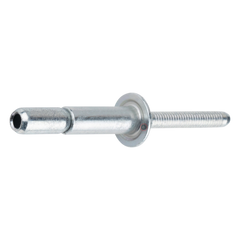
Structural Rivet Types.
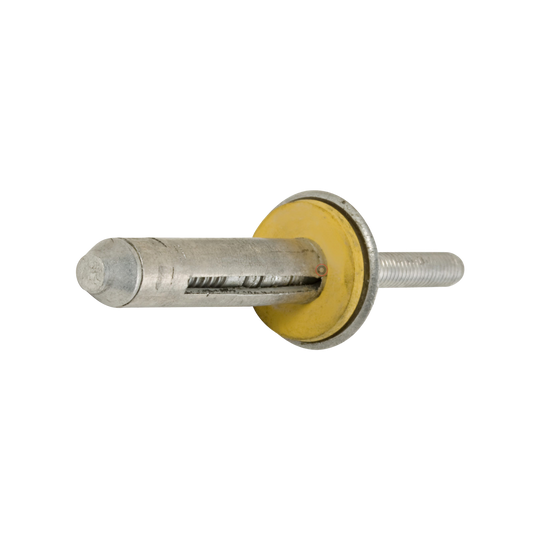
Tri Bulb Rivets - Tri Folding Load Spreading Aluminum Rivets.
These rivets have a slotted body that assist in forming a propeller shape blind-side anchor upon installation. The Tri-Bulb Folding structural rivets spread their clamping force through their anchor blades which combines with a washer to provide a weatherproof joint. Great for motor body fabrication where composite materials like those associated with refrigerated or pantech trucks are used. Other tri folding structural rivets include the Bulb -Tite® rivet which is often used for the installation of safety roof anchor points, including the fall arrest system + the rope access system. Subject to using the correct rivet diameter. Read how the Bulb-Tite® structural rivet is better than a general purpose Tri-fold rivet in certain applications.
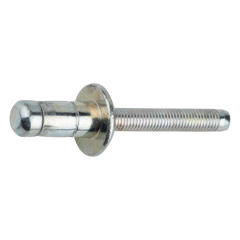
High Strength - Stuctural rivets that locks both sides of the material.
The High Strength Rivet (HSR) range feature a double-locking system that interlocks the material on both sides of the 'panel for better security, providing a vibration and weather resistant joint. These rivets work well within a limited material grip range and have a compact non-protruding blind side bulb that spreads the load, whilst avoiding pull-through. An easy to install rivet via a Huck® gun or a structural rivet tools as a standard rivet gun is not engineered to install structural rivets in big volumes. Also known as Allok® or Hemlok® rivets.
How to Choose Structural Rivets for Construction Applications
Selecting an appropriate structural rivet requires an understanding of the materials being joined, the loads applied to the connection and the conditions in which the assembly will operate.
Several factors should be considered before selecting a structural blind rivet:
1. Load requirements: Assess the expected shear, tensile, vibration and fatigue loading. Manufacturer test values must be considered alongside the overall joint design.
2. Material compatibility: Consider the type, thickness and strength of the materials being joined, along with potential galvanic corrosion between dissimilar metals.
3. Grip range and hole dimensions: Confirm that the selected rivet's specified grip range and hole-size tolerances match the materials and joint configuration.
4. Environmental conditions: Consider moisture, salt exposure, temperature variation and other conditions that may affect corrosion resistance and service life.
5. Installation requirements: Confirm compatibility with the recommended installation equipment and follow the manufacturer's installation and inspection instructions.
6. Engineering verification: For load-bearing, safety-critical or regulated building applications, the fastener and complete joint design must be assessed by a suitably qualified engineer or designer.
Manufacturer technical datasheets should be consulted before finalising fastener selection.
Sydney's leading industrial rivet supplier.
Aerobold® should be your first choice when considering a rivet supplies as we have a comprehensive range and inventory of standard pop rivets like the Open-End Rivets, or Sealed Rivets right through to the specialised Tri-Fold rivets or Peeled rivets. Including, the supply of the structural rivet like the ¼’ Magna-Lok® Huck rivets or the hard-to-find 5/16” countersunk Allok® rivets. Aerobolt®is all these things and so much more with a wide range of rivets, along with air rivet guns, and cordless options.
Industrial rivet suppliers for the construction sector wrap up
Modular construction is not a new concept; however, today's volumetric modular off-site construction has evolved significantly from the pre-fab buildings of the 1940s and 1950s. These structures have undergone a series of innovative improvements and have attracted substantial investment. Modern construction methods are revolutionizing the way we work and live, enabling us to meet the sustainability and efficiency requirements of the twenty-first century.
By installing HuckBolts® and Huck® structural blind rivets, an engineer can count on many benefits including:
-
Mechanical fastening performance: Huck® structural blind rivets and HuckBolts® provide different permanent fastening solutions. Selected products incorporate locking features designed to resist loosening under vibration.
-
Installation accessibility: Huck® structural blind rivets can be installed from one side of a joint, making them useful in assemblies where access to the rear of the material is limited. HuckBolt® lockbolts have different access and installation requirements.
-
Potential installation efficiency: In suitable applications, mechanically installed fasteners may simplify assembly compared with alternative joining processes. Actual installation times depend on the fastener, tooling, operator, joint preparation and comparison method.
-
Long-term joint performance: Durability and maintenance requirements depend on the selected fastener, material compatibility, corrosion exposure, loading conditions and inspection requirements.
-
Joint security: Mechanical locking systems can provide secure connections when the fasteners are correctly selected and installed. Connection integrity must be verified against the requirements of the application.
-
Application-specific safety: Mechanical fastening may offer an alternative to certain welded or bolted assemblies when approved by the project designer. Appropriate installation procedures, workplace safety controls and engineering assessments remain essential.
Aerobolt's dedicated support team strive to elevate customer experience by providing comprehensive assistance for your industrial riveting requirements. We excel in selecting suitable installation tools, ensuring accurate industrial rivet installations, and optimising the workflow process. The Huck® fastener range remains our primary focus due to its reliability and efficiency, enabling hassle-free assembly in modular building and various other construction applications.
Important Technical Information
The information provided in this article is intended as a general guide to Huck® structural fasteners and their potential applications. It is not a substitute for engineering design, manufacturer installation instructions or project-specific technical assessment.
For load-bearing, safety-critical or regulated building applications, the fastener type, diameter, material, grip range, installation method and complete joint configuration must be verified by a suitably qualified engineer or designer.
Customers should consult current manufacturer technical documentation and applicable Australian construction requirements before specifying or installing structural fasteners.
 (60+)